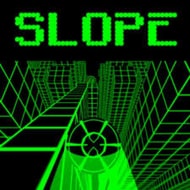
You’re deep into a run, the neon track blurring under the ball, when a red block appears a half-second later than your eyes want it to. You flick the direction key, clip the corner anyway, and watch the slope go dark. That moment, repeated endlessly, is basically what Slope is: a downhill rolling-ball game where the track ends your run far more often than you do.
| Genre |
Endless 3D arcade runner |
| Platform |
Browser, desktop and mobile |
| Controls |
Left/Right arrow keys or A/D, swipe on touchscreens |
| Objective |
Survive as long as possible and rack up a distance-based score |
| Camera |
Close, dynamic view positioned behind and above the ball |
| Setting |
Procedurally generated neon downhill track with platforms, gaps, and red obstacle blocks |
The Core Loop: Steering a Ball That Never Stops Accelerating
Underneath the neon coating, the mechanic is simple. The ball rolls forward on its own, gravity pulls it downhill, and the only thing you control is lean: nudge left, nudge right, and hope the platform is still there. There’s no jump button and no brake, so every decision comes down to timing a small lateral shift before the track decides for you. The camera sits close behind and slightly above the ball, so each segment arrives in real time rather than something you can plan ahead.
Speed climbs continuously from the first second and never resets until you crash.
Scoring is tied directly to distance traveled, not coins or pickups, so the number on screen is really a stopwatch for how long you kept the ball on track. There’s no upgrade shop and no final boss. That’s part of what keeps people opening the game between other tasks: a run can be four seconds or four minutes, and either way it ends the instant you decide to try again.
Why First Slope Runs End in Under Ten Seconds
Almost everyone who picks up Slope for the first time makes the same mistake: they steer like they’re driving a car instead of nudging a ball. Sharp taps send it skidding wide of center, and once it’s near the edge, a second correction usually overshoots off the far side. The instinct to yank the key harder as speed increases is backwards: the faster the ball moves, the smaller each input needs to be, since a big correction has nowhere to go but off the platform.
Panic is the other big killer. The moment a cluster of red blocks or a gap appears, freezing and overcorrecting end a run just as fast as doing nothing.
Casual players grabbing a quick break tend to bail the moment the track first narrows, which is fine, since the game is built around instant restarts rather than long warm-ups. There’s no loading screen between attempts, just a fresh slope generating as soon as the last one goes dark.
How the Slope Ramps Up the Longer You Survive
Early on, before speed ramps up, the track is genuinely forgiving. Platforms are wide, red blocks are spaced out, and gaps are narrow enough to cross without much thought. That early stretch is deceptive, though, since it trains a rhythm that stops working once the pace picks up. Deep into a run, the same obstacles start clustering together, platforms narrow into single-file strips, and the reaction window between spotting an obstacle and dodging it shrinks to almost nothing.
The escalation isn’t scripted into distinct levels. It’s a smooth, continuous curve, which is why the game feels so different to a player who’s cleared a modest distance versus one who’s pushed well past it: the mechanics never change, only the time you’re given to use them.
This is where a second kind of player shows up: the ones treating the game less as something to beat and more as a reflex drill, running short bursts to sharpen reaction time before doing something else entirely. For them the escalating speed isn’t a problem to survive, it’s the whole point.
Reading Speedtunnels Before They Read You
One track feature that trips up even experienced players is the speedtunnel, the enclosed, ramped sections that briefly boost the ball’s velocity. A trick regulars pass around is riding the side ramps instead of holding the center line, since at higher speeds the ball is far more likely to clip the exit ramp coming out of the middle than while riding one side. It’s a small adjustment, but the kind of thing you only learn after losing a run to it first.
Narrow sections right after a speedtunnel catch people off guard too, since the ball still carries the extra speed once the platform width drops.
The Habits That Separate Long Runs from Short Ones
Players chasing long distances stop treating the direction keys as on-off switches and start using them the way you’d use a steering wheel on ice: constant, tiny corrections rather than committed turns. Staying near the center of the track is the single most repeated piece of community advice, since it buys extra fractions of a second to react to whatever comes next, whether that’s a red block, a gap, or a sudden narrowing. Anticipating repeating platform patterns helps too, since certain obstacle clusters recur often enough that a practiced player spots them a beat before they’re on screen.
Speedrunners chasing a personal best tend to run in short, focused sessions rather than marathon sittings, resetting the instant a run goes sideways instead of grinding out a comeback from a bad position. Others treat every run as disposable and play in long stretches, letting the score climb or crash without much ceremony.
Touch controls on mobile feel less precise than a keyboard to many players, a divisive point in the community: some argue swipe input is fine once you adjust sensitivity expectations, others maintain the game is built around keyboard timing and touch always feels a step behind. Both camps have a point, and the difference shapes which platform people recommend to newcomers.
Details You Only Notice After Enough Runs
Spend enough time on the slope and you notice the red blocks’ hitboxes feel slightly more forgiving than the model suggests at a glance, so a near-miss that looks like a hit onscreen sometimes isn’t, and a graze that looks clean sometimes is. That detail changes how experienced players read close calls compared to someone on their first few attempts, who assumes any visible overlap means an automatic wipeout.
The community has its own shorthand for all this: a bad crash is a wipeout, over-correcting into an obstacle is a panic-steer, and clipping the edge of a ramp exit, especially inside a speedtunnel, is just called clipping.
Controls in Slope boil down to two directions, left and right, with no third input for jumping or braking, and that restriction is precisely why the game rewards small, deliberate movements over dramatic ones. The whole system reads as designed around that two-key limitation rather than as an accident.
What are the controls for Slope?
On a keyboard, Slope is steered with the left and right arrow keys, or A and D, with no other inputs needed since there’s no jump or brake. On touchscreens, the same steering is handled by swiping toward the side you want the ball to lean.
Does Slope ever end or have a final level?
No. The track generates continuously and there’s no final stage, boss, or win screen. A run ends only when the ball collides with a red block or falls off the edge of the current platform, at which point the score locks in and a new slope starts immediately.
How do you get a higher score in Slope?
Stay near the center of the track for maximum reaction time, use small taps instead of full holds, and on speedtunnels ride the side ramps rather than the middle to avoid clipping the exit at higher speeds. Resetting quickly after a bad run instead of tilting matters just as much as any single technique.
None of that changes what Slope actually is underneath the neon: two keys, one accelerating ball, and a slope generating red blocks and speedtunnels just fast enough to catch you the moment you stop paying attention. It’s a short, sharp loop rather than a sprawling game, and that’s exactly why a five-minute visit so often turns into fifteen.